The cryptographic lifecycle involves algorithm selection, key management, and the management of encrypted data at rest, in transit, and in storage.
Algorithm selection involves a number of choices:
- The type of cryptology appropriate for the purpose (e.g. symmetric, public key, hashing, etc.)
- The specific algorithm (e.g. AES, RSA, SHA, )
- The key length (e.g. AES-256, RSA 2048, SHA512, )
- In the case of symmetric encryption, the operating mode (ECB, CBC, )
Symmetric encryption is best for storing data at rest that has to be recovered (decrypted) before being used. Symmetric encryption is also far more efficient than public key cryptography, and so is appropriate for protecting data in transit. The problem, as explained in detail below, is that for symmetric cryptography to be used for data in transit, both ends of the communications link must have knowledge of the secret key. There are a number of methods for securely exchanging keys over an insecure channel, the most widely used of which uses public key cryptography (also discussed below).
There are some types of data that need to be protected but that do not need to be decrypted. In fact, for security, it is best that some data never be able to be decrypted. For example, to protect the confidentiality of passwords used for user authentication, they obviously have to be encrypted. But there is no need to be able to decrypt them. To verify an entered password against the previously stored password, all one need do is encrypt the entered password and compare the two ciphertexts. In fact, being able to decrypt passwords significantly weakens their security. So, for this purpose we use a one-way encryption function, otherwise known as cryptographic hashing. To be clear, cryptography is not exclusively encryption and decryption. Cryptography uses an algorithm that, regardless of its level of complexity, deals with an input and an output. Cryptographic hashing inputs a string to produce an output, which is generally assumed to be an output of fixed length, regardless of the input length.
Another example is the use of credit card numbers within a billing system. While the system that submits the transaction to the payment processor obviously has to be able to access the account number in plaintext, there are many databases and logs in which the account number needs to be stored. For most of those, it is sufficient to store a cryptographic hash of the account number. This hash can be stored and communicated without significant risk should it be disclosed. Only a very limited number of systems need store the account number using a symmetric cipher which can be decrypted. In this manner, the attack surface is sharply reduced.
Another technique to protecting the primary account number (PAN) is to disassociate the number from the account holder and any information that can identify that account holder. In and of itself, the PAN is like a token. Only when the PAN can be linked to PII does the credit card number become sensitive information. Translation vaults are being used to generate a random token with which the PAN is securely linked. This tokenization process helps separate account numbers from the PII by providing an encrypted relationship between the two.
Having chosen the type of cryptography, one must select the appropriate algorithm. In some cases, the set of algorithms is constrained by protocol standards. For example, if one is using cryptography to protect data in transit, then the standard lists the supported algorithms, and your choice is limited by the standard as well as a desire to remain compatible with as wide a range of browsers as reasonably possible.
Symmetric cryptography is the use of a single key, shared between two or more par- ties. Symmetric algorithms are broadly divided into block and stream ciphers. As the names imply, block ciphers take a block of data (typically 8, 16, or 32 bytes) at a time. Stream ciphers take either a single bit or single byte at a time. Block ciphers are typically used in bulk encryption, such as with data at rest, while stream ciphers are optimized for encrypting communications links. Stream ciphers frequently have the property of being able to quickly resynchronize in the face of dropped or corrupted bits. Block ciphers in certain chaining modes are unable to resynchronize, and the loss or corruption of the data stream will make the remainder of the transmission unable to be decrypted. It is possible, at the cost of some (or considerable) efficiency to employ a block cipher as a stream cipher and vice versa.
On communications links in which lower levels of the protocol handle error detection and retransmission, block ciphers are typically used (e.g. in TLS and WiFi).
In other cases, such as encrypting data to be stored in a database, one could choose any symmetric block algorithm. In this case, one ought to turn to the guidance provided by national research organizations (such as NIST in the U.S., the National Cyber Security Centre in the UK, or the International Standards Organization). These agencies make recommendations on appropriate algorithms based on an analysis of their relative strengths.
Other considerations include the efficiency of the algorithm. If the code is to be implemented on a system that has limited processing power or will have to encrypt large amounts of data, small differences in algorithm efficiency have a big impact on performance. Consider also that some processors include coded support for certain algorithms. Having support in the processor instruction set for certain algorithms makes their operation much faster than without the processor support. For example, most Intel, AMD, and ARM processors include instructions to speed up the operation of the AES algorithm.
One study found an 800 percent speedup from using CPU-accelerated cryptography.
The longer the key, the more secure the cipher. But longer keys mean more processing time. You have to balance the security of long (strong) keys with the impact on system performance. An important consideration is the lifetime of the encrypted data. If the data can be reencrypted periodically (say, every year or two years), then selecting a key that is likely to withstand advances in brute-force attacks over the next two decades is not important. Conversely, if the data is likely to be archived for long periods of time, a longer key may be required. (The details of key management and key lifetimes are discussed at greater length later in this chapter.)
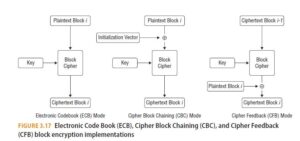
With symmetric block encryption, there are a number of ways to use the algorithm. Figure 3.17 shows the main variants from the simplest, Electronic Code Book (ECB) mode, to the more complex Cipher Block Chaining (CBC) and Cipher Feedback (CFB) modes. These are discussed further in the next section.
One final note, the choices outlined above are only optimal at a point in time. Weaknesses in cryptographic algorithms are discovered, more powerful processors make brute-force attacks more viable, and the development of quantum computing may make certain algorithms obsolete. There have been countless examples in the past of previously considered secure algorithms being deprecated because of advances in cryptanalysis, such as DES, RC4, SHA-11, and others.
Not only do cryptographic keys have finite lifetimes, so do cryptographic algorithms. It is periodically necessary to revisit the choices made to determine if they still provide the security necessary. This also means that systems need to be designed so that changing the cryptographic algorithm can be done with a minimum of disruption.